
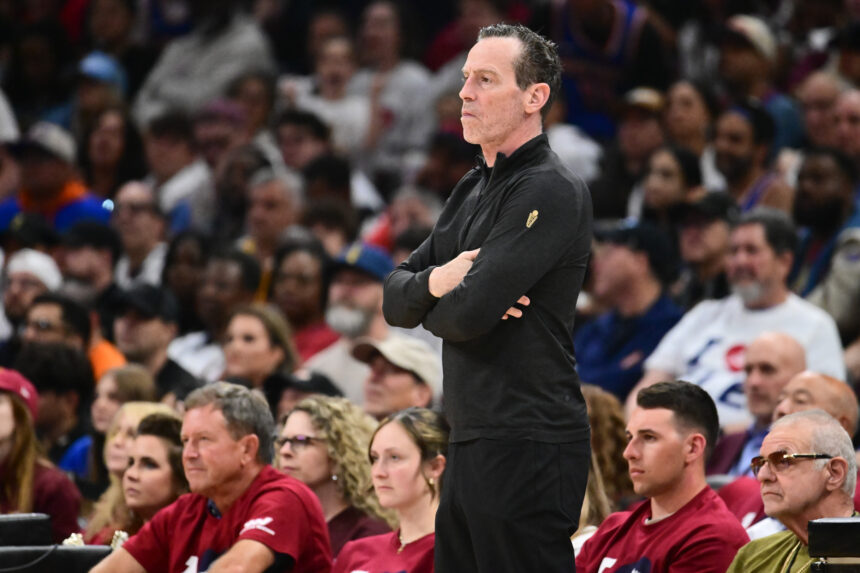
Kenny Atkinson is leaving the Cleveland Cavaliers’ starting lineup open heading into training camp, with competition for minutes extending well beyond the first five.
The Cavs coach has yet to finalize his starters.
“The starting lineup is not set,” said Atkinson. “We have a whole training camp to work through that.”
Atkinson believes he could make a case for using 13 players in the rotation. That leaves the staff with two related decisions: which group opens games and how to distribute the minutes that follow.
Cavaliers Nation’s earlier projected depth chart placed James Harden, Donovan Mitchell, Peyton Watson, Evan Mobley and Jarrett Allen together. Atkinson’s comments make clear that combination should still be treated as a projection.
The remarks do not identify a player who has lost a starting job or establish which positions are under consideration. They do give Cleveland’s camp a more consequential question than how to arrange the bench.
Why the Cavs have options on the wing
Watson averaged 14.6 points and 4.9 rebounds per game for Denver before joining Cleveland in a five-team trade.
There is experience among the returning options, too. Jaylon Tyson started 42 games and shot 44.6 percent from three last season. Sam Merrill made 38 starts and hit 42.1 percent of his 3-pointers on 7.2 attempts per game.
Those numbers matter because the lineup discussion involves players who have already handled starting assignments. Merrill’s combination of accuracy and volume supplies an offensive reason to examine different perimeter combinations, while Tyson’s production gives the staff another established shooting option to consider.
Neither shooting percentage settles the choice. A lineup also has to defend its matchups, rebound and function when opponents take away its preferred action.
Camp gives Atkinson a chance to compare those trade-offs with the actual players on the floor together. Watson said last week that Cleveland’s rim protection would give him “a lot more leeway” defensively.
That offers a useful test for camp: Does a particular combination help Cleveland pressure the ball without creating problems elsewhere?
The answer could influence both the starting group and the units Atkinson uses after his first substitutions.
13 candidates create a minutes problem
Atkinson’s assessment of the rotation also deserves attention independently of the starting-lineup question. Seeing a case for 13 players does not mean he has committed to playing all 13 every night.
An NBA regulation game provides 240 player-minutes. Divided equally among 13 players, that would leave roughly 18.5 minutes apiece.
Once some players take larger workloads, the remaining opportunities shrink quickly. For the players outside the opening five, the important camp question therefore becomes what a particular unit needs.
An additional ball-handler may help one combination, while another may benefit more from shooting or an extra frontcourt option. Earning a role requires showing where a player makes the group better.
Cleveland’s 21-player camp roster and itinerary lay out the next stage of that evaluation. Practices in Spain begin Sept. 30, with a scrimmage scheduled in Malaga on Oct. 4.
The revealing development will be which combinations Atkinson tests repeatedly and whether those groups carry into preseason play. For now, the coach has left himself room to evaluate both the starters and the rotation around them.