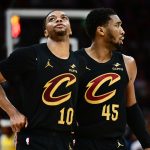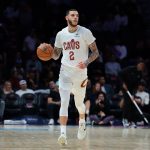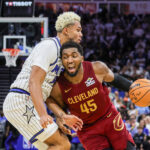
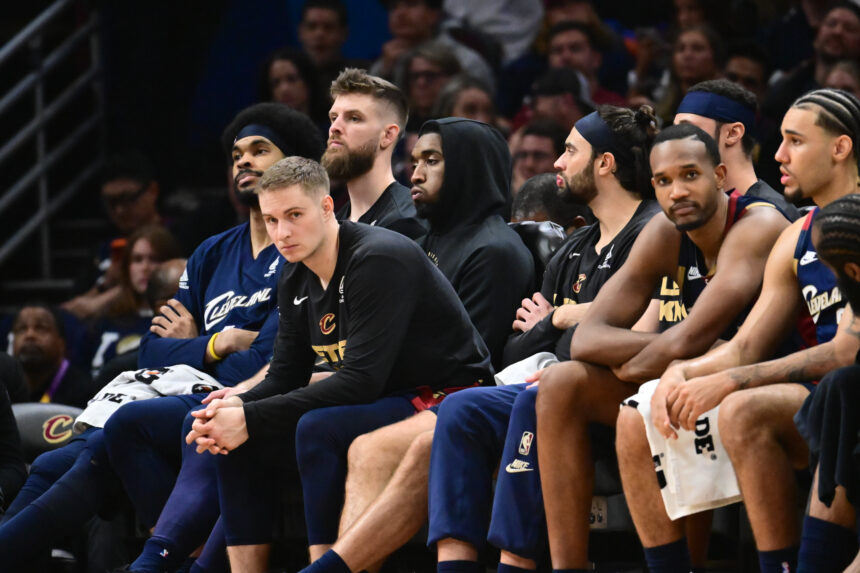
The Cleveland Cavaliers have named the 21 players on their training camp roster, including four invitees who will join the team for its trip to Spain.
Thursday’s official announcement identifies Rashaun Agee, Zack Austin, Curtis Jones and Kadary Richmond as camp invitees. Tristan Enaruna, Riley Minix and Ernest Udeh Jr. occupy the three two-way spots, with 14 other players completing the group.
That breakdown leaves Cleveland with a decision beyond how to arrange its rotation: whether anyone earns a place alongside those 14 on the regular-season roster. A camp invitation provides an opportunity to make that case, but the Cavs do not have to keep a 15th player simply because the position is available.
Who is on the Cavs’ training camp roster?
The team’s roster designations separate the group as follows. The regular-roster category below means players not marked as two-way players or camp invitees; it does not describe the guarantees in their individual contracts.
Regular-roster group (14):
- Jarrett Allen
- Thomas Bryant
- Khalifa Diop
- James Harden
- Mario Hezonja
- Sam Merrill
- Donovan Mitchell
- Evan Mobley
- Craig Porter Jr.
- Tyrese Proctor
- Meleek Thomas
- Nae’Qwan Tomlin
- Jaylon Tyson
- Peyton Watson
Two-way players (3):
- Tristan Enaruna
- Riley Minix
- Ernest Udeh Jr.
Training camp invitees (4):
- Rashaun Agee
- Zack Austin
- Curtis Jones
- Kadary Richmond
The Cavaliers also shared the announcement on their official account:
📝 Our Training Camp roster is here! @ClevelandClinic | #LetEmKnow pic.twitter.com/pgeVvcM0tk
— Cleveland Cavaliers (@cavs) September 24, 2026
The four invitees joined the roster Wednesday, according to their signing dates on NBA.com’s team page. Thursday’s release establishes the complete camp group.
Why a full camp roster still leaves decisions for Cleveland
Under the NBA’s collective bargaining rules, teams can carry 21 players during the offseason and training camp. The regular-season limit is 15 standard-contract players, with up to three additional players on two-way contracts.
Teams generally must carry 14 or 15 standard-contract players, subject to limited exceptions. Cleveland therefore has room to retain one of its invitees alongside the other 14, assuming that group and the two-way assignments remain intact.
It could also enter the season with 14 or consider someone who becomes available elsewhere. The announcement does not commit the front office to any of those outcomes.
That makes fit more relevant than a simple ranking of the four invitees. A player would need to offer something Cleveland wants to carry on its NBA roster, whether that is additional ball-handling, a defensive option or depth at a position where camp reveals a need.
A productive scrimmage alone would not answer those questions. There is also a development route beyond the NBA roster.
The G League’s explanation of roster construction describes how NBA teams can bring waived camp players into their affiliate systems. Such players remain NBA free agents; joining an affiliate does not itself secure a spot with the parent club.
For Cleveland, that means an invitee could make a useful impression without remaining on the Cavaliers’ opening roster. The Charge can provide a place for further evaluation, though Thursday’s announcement does not establish where any of the four will ultimately play.
Meleek Thomas faces a different kind of camp test
The distinction between earning a roster place and earning minutes also matters for the players outside the invitee group. Thomas, for example, arrives with a scoring performance worth testing against the demands of an NBA rotation.
Thomas led Las Vegas Summer League with 27.3 points per game across four games in July.
That production supplies a reason to watch him closely, but his camp evaluation should extend beyond how often he scores. Playing alongside established teammates changes the assignment: He will need to make decisions when the possession is not designed for him, contribute without dominating the ball and hold up defensively.
Those are questions to evaluate, rather than conclusions the summer scoring average can settle. Cleveland’s projected depth chart provides the broader rotation picture; the work in Spain will begin testing how those pieces actually function together.
When does Cavs training camp begin?
The newly released itinerary lists arrival in Spain on Sept. 29, followed by practices at The Embassy in Andalusia beginning Sept. 30.
- Sept. 30 and Oct. 1: Practice from 6-8 a.m. ET.
- Oct. 2: Practice from 6-7 a.m. ET.
- Oct. 3: Practice from 6-8 a.m. ET.
- Oct. 4: Scrimmage at Martin Carpena Arena in Malaga from 6-8 a.m. ET.
The team lists media availability after each session. Those are scheduled team activities; the release does not identify a live broadcast for the practices or scrimmage.
Cleveland’s first preseason game is at home against Boston on Oct. 8 at 7 p.m. ET, with RESN on DAZN listed as the broadcaster in Thursday’s release. The Cavs’ preseason schedule then continues with two games against Orlando.
By the Boston opener, the coaching staff should have a better basis for deciding which players deserve longer looks. Thursday settled who is in the camp group; the next step is determining what each player can contribute.