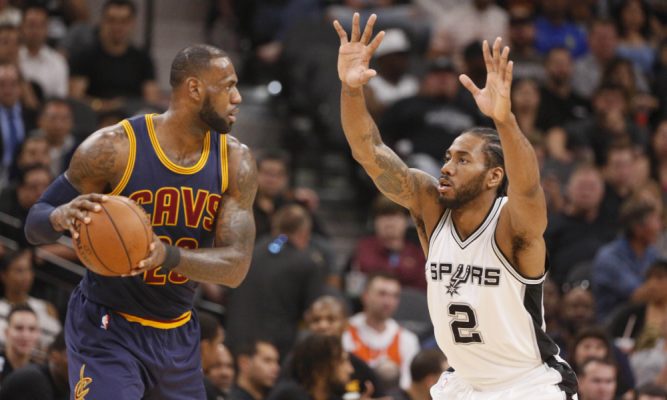
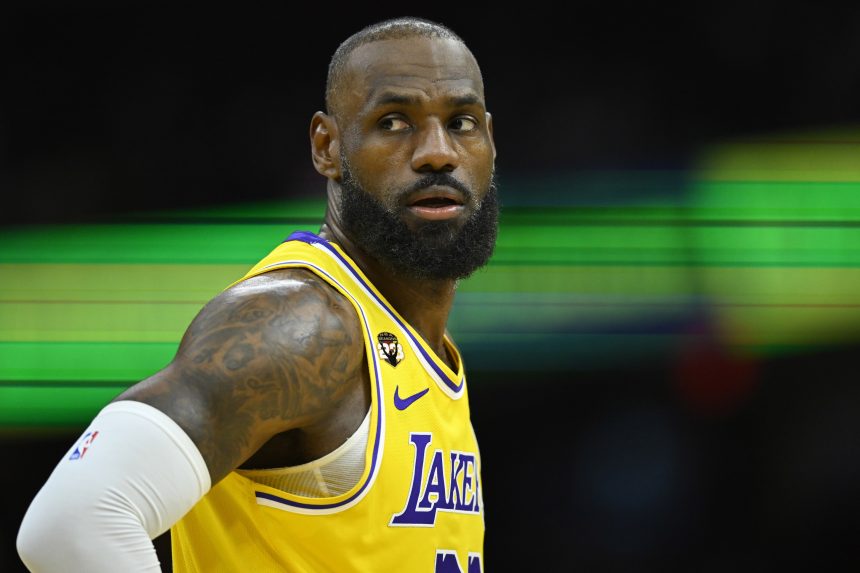
LeBron James will play the 2026-27 season somewhere other than Los Angeles.
Hours before free agency opened on Tuesday, his agent Rich Paul told the Lakers that James is planning to sign elsewhere, ESPN’s Shams Charania reported. The move closes an eight-year run in the purple and gold and immediately revives a question Cleveland has circled for more than a year: Could the franchise’s defining player come home one final time?
On Cleveland’s end, the interest is real. NBA on Prime’s Chris Haynes reported Tuesday that the Cavaliers would welcome a reunion, drawn to the idea of James closing out his career in the city where it began.
The appeal is easy to understand. So is the obstacle, and it has nothing to do with desire. It is the salary cap, and for Cleveland it is a punishing one.
A reunion Cleveland has every reason to want
For the fan base, the pull is almost entirely emotional, and reasonably so. James entered the league as the No. 1 overall pick in 2003, delivered the only championship in franchise history in 2016 and departed for a second time in 2018.
A return now would be a third stint and, in all probability, the closing chapter of a career that started 40 minutes south in Akron. The basketball logic is not far behind. Cleveland is coming off a season that ended in a sweep in the Eastern Conference finals, and the roster around Donovan Mitchell is built to win immediately.
Adding James to a core of Mitchell and James Harden with Evan Mobley and Jarrett Allen anchoring the frontcourt, would hand head coach Kenny Atkinson one of the deepest top-end rotations in the conference. On paper, it is exactly the kind of veteran addition that nudges a contender up the East’s pecking order.
The money is the entire story
This is where the romance meets the spreadsheet. Cleveland does not have the tool that James’s rival suitors can dangle. The Golden State Warriors, viewed as the frontrunner, can offer the full non-taxpayer mid-level exception, projected at roughly $15 million. The Cavaliers cannot.
Operating deep into the luxury tax, Cleveland has no access to that exception. The most the team could put in front of James outright is the veteran minimum, a figure that lands near $3.9 million for a player of his service time — a number that has never once been part of his free-agency vocabulary.
For a straight signing, in other words, the Cavaliers would be asking the greatest player in their history to leave roughly $11 million on the table relative to what Golden State could pay.
The alternative is a sign-and-trade, and that route comes with its own toll. Any sign-and-trade would hard-cap Cleveland at the first apron, a threshold the Cavaliers already sit well above once Harden’s next contract returns to the books.
Getting under that line would force the front office to shed real salary, which is why the most frequently floated framework has Cleveland sending Allen and his sizable contract to a Lakers team desperate for a center, opening just enough room to bring James in at a reduced figure.
The Harden domino
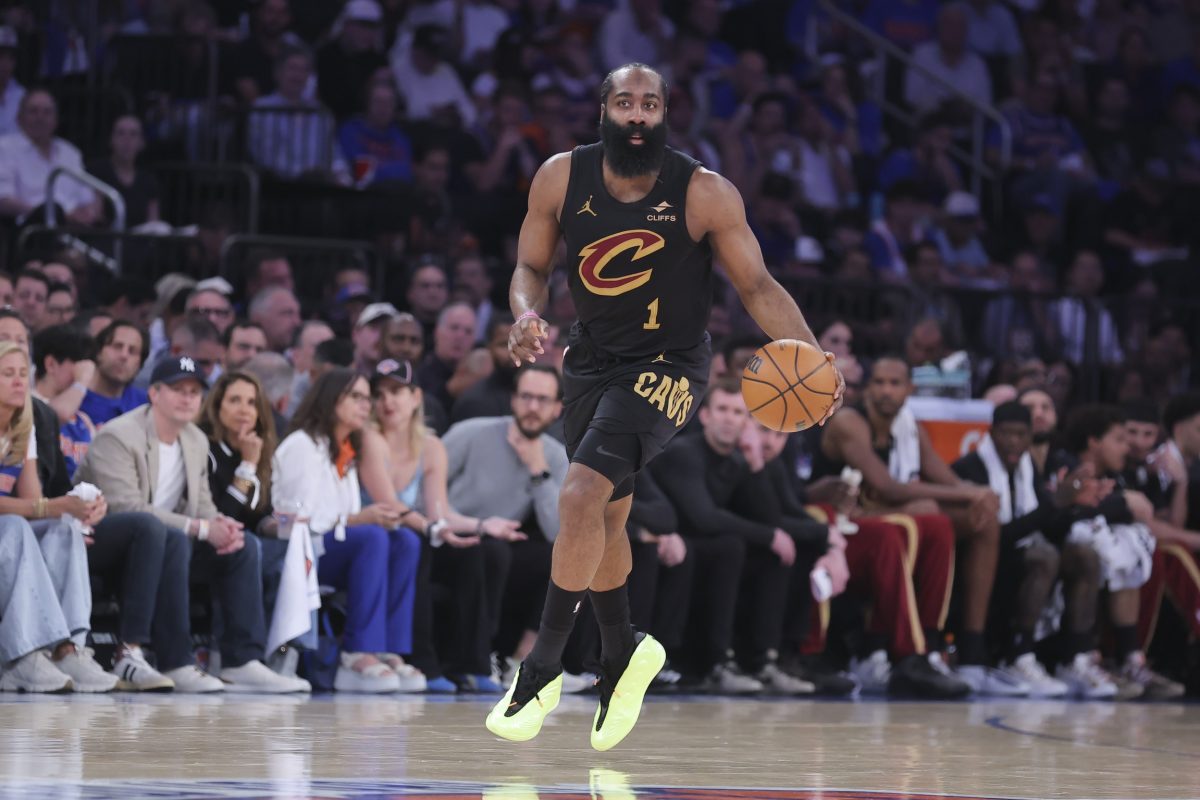
None of it moves without James Harden. Harden is declining his $42.3 million player option for next season and working with the Cavaliers on a new multiyear deal, Charania reported. The mechanics there matter as much as the headline. By spreading a lower first-year salary across more seasons, Harden’s new contract can be structured to soften Cleveland’s cap hit for 2026-27 rather than balloon it.
That gives the Cavaliers a sliver of room they would not otherwise have, and it explains why the order of operations is so delicate. Harden’s deal and any James pursuit are financially intertwined, and Cleveland cannot finalize one without knowing the shape of the other. The flexibility a James run requires is measured in single-digit millions, which leaves almost no margin for error.
What Cleveland would have to move
Clearing first-apron room means subtraction, and the front office has already started exploring it. Cleveland has discussed Max Strus and Dennis Schroder in trade talks, Cleveland.com’s Chris Fedor reported Tuesday. Moving one or both would be the most direct way to manufacture the breathing room a James signing demands.
The complication is that the Cavaliers are managing their own free agents at the same time. Even amid the James buzz, Cleveland has stayed engaged with forward Dean Wade about a possible return.
Re-signing rotation pieces and clearing money for a star addition tug in opposite directions, and the front office cannot fully do both. Every dollar spent keeping the supporting cast intact is a dollar that complicates the path to James.
The Warriors are not going away
Cleveland is not bidding in a vacuum. Golden State has emerged as the most aggressive outside suitor, described by veteran reporter Marc Stein as “the league’s most interested external suitor” for James. The Warriors can offer the full mid-level, keep him on the West Coast near family and surround him with Stephen Curry and Draymond Green for one last title push.
That blend of money and convenience is precisely what Cleveland cannot match dollar for dollar, which is why the Cavaliers’ pitch has to lean on something the cap sheet cannot quantify: home.
Bottom line
Strip away the sentiment and the arithmetic is unforgiving. For a homecoming to happen, one of two things has to give. Either James accepts a minimum or near-minimum salary to force it through, or Cleveland executes a sign-and-trade that costs it a rotation anchor like Allen and somehow threads the first-apron needle.
Neither is simple, and both demand a sacrifice neither side has yet signaled it is ready to make. The interest is genuine. With free agency now open, the coming days will determine whether it ever becomes anything more.