

Training camp is a little more than two weeks away, and the Cleveland Cavaliers’ starting five is the least interesting question on the roster.
Barring an injury, James Harden, Donovan Mitchell, Peyton Watson, Evan Mobley and Jarrett Allen will open the season together. What Kenny Atkinson does with the four or five spots behind them is where the 2026-27 season gets decided, because the bench he trusted in May no longer exists.
Three of the nine players Atkinson leaned on in the playoffs are gone. Max Strus averaged 26.7 minutes per game across Cleveland’s 18 postseason games; Dean Wade averaged 22.6 and started 14 of those games; and Dennis Schroder averaged 15.9, according to Basketball-Reference.
Add it up and Cleveland has 65.2 minutes a night, roughly 27 percent of the available floor time, to redistribute before opening night.
The offseason answer was Watson, Mario Hezonja and a bet that the young players already on the roster can take a step. Here is how the depth chart projects with camp approaching, where the real competition sits and which spot is still open.
Projected Cavs depth chart for 2026-27
- Point guard: James Harden, Craig Porter Jr., Tyrese Proctor
- Shooting guard: Donovan Mitchell, Sam Merrill, Meleek Thomas
- Small forward: Peyton Watson, Jaylon Tyson
- Power forward: Evan Mobley, Mario Hezonja, Nae’Qwan Tomlin
- Center: Jarrett Allen, Thomas Bryant, Khalifa Diop
- Two-way: Ernest Udeh Jr.
That is 14 players on standard contracts plus Udeh on a two-way deal, which leaves one open spot.
Cleveland created the room by waiving Cam Whitmore late last month rather than carrying him into camp, then used the 14th slot on rookie center Khalifa Diop. Hezonja is listed at the 4 here on purpose, and the reasoning is below.
The starting 5 is set, and it is younger on the wing
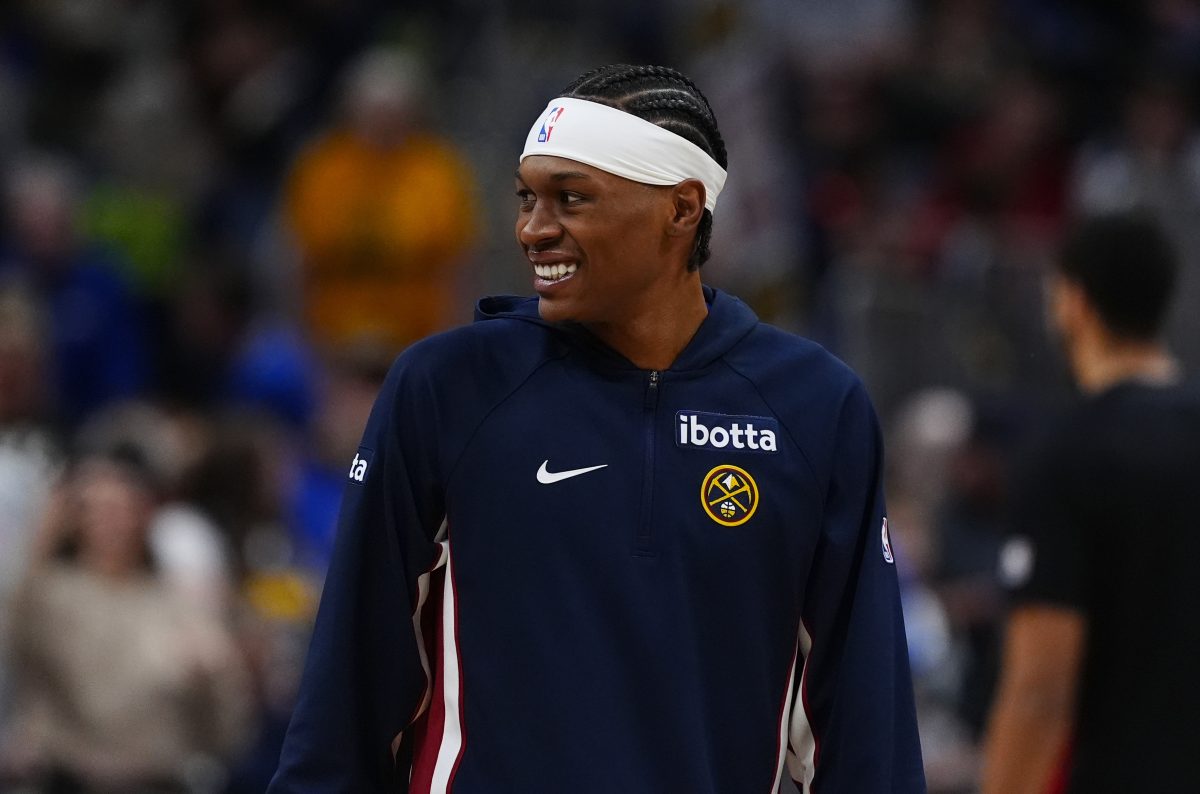
Watson turned 24 on Friday and arrives off the best season of his career. He averaged 14.6 points, 4.9 rebounds and 2.1 assists per game in 29.6 minutes across 54 games for Denver, starting 40 of them, and hit 41.1 percent of his 3-pointers after entering the year as a career 36.1 percent shooter.
He also averaged 1.1 blocks and 0.9 steals per game, which is the part of his profile Cleveland actually paid for. The price was Strus, an unprotected 2031 first-round pick and a 2032 Sacramento second-rounder, with Watson signing a four-year, $88 million contract that carries a player option and a trade kicker.
The deal eventually expanded to five teams. Koby Altman framed the fit around versatility, saying Watson’s “length, athleticism and defensive versatility” let Cleveland use him across multiple positions.
The one caveat is health. Watson missed Denver’s playoff run with a hamstring injury he first suffered in February and aggravated in April, so camp is the first live look at whether he is all the way back.
Around him, the core is what it was in the spring. Mitchell, who turned 30 on Monday, averaged 27.9 points, 4.5 rebounds and 5.7 assists per game in 70 games and made the All-NBA Second Team.
Harden, who officially re-signed Tuesday, averaged 20.5 points, 4.8 rebounds and 7.7 assists per game and shot 43.5 percent from deep in his 26 regular-season games after the trade.
Mobley averaged 18.2 points, 9.0 rebounds and 1.7 blocks per game, and Allen averaged 15.4 points and 8.5 rebounds per game on 63.8 percent shooting. Those five accounted for nearly every meaningful minute in May, and they will again.
Who inherits the 65 minutes
Watson takes Strus’ 26.7 more or less in full, which means the real accounting is about Wade’s 22.6 and Schroder’s 15.9.
Sam Merrill is the first wing off the bench and the safest bet in the second unit. He averaged 12.8 points per game and shot 42.1 percent on 7.2 3-point attempts per game across 52 regular-season games, starting 38 of them while Strus was out.
His playoff minutes dipped to 19.9 per game, but with Strus gone that number should climb back toward his regular-season workload of 26.5.
Jaylon Tyson is the swing piece. The 23-year-old averaged 13.2 points, 5.1 rebounds and 2.2 assists per game and shot 44.6 percent from three in the regular season, starting 42 of 66 games.
Then Atkinson cut him to 12.7 minutes per game in the playoffs, and he hit 23.7 percent of his 3s in that sample. If the regular-season Tyson shows up in October, Wade’s minutes have an obvious home.
If the playoff version does, Cleveland has a problem. That is where Hezonja comes in, and why he sits at the 4 on this chart rather than the wing.
The 31-year-old signed a one-year deal in July after winning the 2025-26 Liga ACB MVP with Real Madrid, where he averaged 15.0 points, 4.3 rebounds and 2.1 assists in 23.1 minutes across 80 appearances.
He has not played an NBA game since the 2019-20 season. Wade’s job in the playoffs was to start next to Mobley as a stretch 4 who could switch, and at 6-foot-8 with a scorer’s confidence, Hezonja is the only forward on the roster who can plausibly replicate the shooting half of that role.
Tomlin, the other option, shot 23.5 percent from three last season.
The backup point guard is the real camp battle
Schroder’s 15.9 playoff minutes per game were the backup point guard minutes, and Cleveland did not replace him with a veteran. Three players are competing for them.
Craig Porter Jr. is the incumbent. He played 64 regular-season games at 17.9 minutes per game and averaged 4.5 points, 3.4 rebounds and 3.2 assists per game on 45.0 percent shooting.
The problem is what happened next: Atkinson played him 3.0 minutes per game in seven playoff appearances. The coaching staff knows exactly what Porter is, and it did not trust it in May.
Tyrese Proctor is the second-year option. The 22-year-old out of Duke played 50 games at 10.9 minutes per game as a rookie, averaged 5.4 points per game and shot 35.1 percent from three and 88.9 percent from the line.
He has the size to guard three positions, which matters on a bench that will lean on two guards who cannot. Meleek Thomas is the upside.
Cleveland took the Arkansas guard 34th overall in June, and he led the entire Las Vegas Summer League in scoring at 27.3 points per game across four games, shooting 50 percent from the field and 43.8 percent from three on his way to an All-Summer League First-Team selection.
He turned 20 last month, and it is seen as a one-spot race between Proctor and Thomas, with Porter opening as the backup.
The likeliest outcome is that Porter starts the season with the job because Atkinson defaults to the known quantity, Thomas gets early G League reps with the Charge between spot appearances, and Proctor is the one whose standing is genuinely decided in camp.
The Cavaliers have Thomas on a four-year deal and can afford patience. They have less reason to be patient with the player they nearly stopped using in the playoffs.
Backup center is the thinnest spot on the roster
Allen played 27.1 minutes per game in the regular season and 29.4 in the playoffs, which leaves roughly 20 minutes a night at center for someone else, and Mobley covered most of them in May. Behind those two, the options are thin.
Thomas Bryant played 60 games at 12.2 minutes per game, averaged 6.2 points and 3.4 rebounds per game and shot 35.9 percent from three.
He played 4.6 minutes per game in nine playoff appearances. Tomlin is a 6-foot-8 forward playing up a position.
Diop is a rookie. Udeh, the two-way big out of Miami, offers rim protection and lob finishing but not much else yet.
This is the most logical use of the open 15th spot, and the fact that Cleveland has not filled it suggests the front office is either waiting on the training camp waiver wire or preserving flexibility for something larger.
Either way, the backup center minutes are the softest part of the depth chart heading into camp.
What to watch when camp opens
Four questions decide how much of this chart survives October. Whether Watson’s hamstring is fully behind him.
Whether Atkinson uses Hezonja at the four beside Mobley or keeps him on the wing and asks Tomlin to fill Wade’s role. Which of Proctor or Thomas earns the ninth spot.
And whether the 15th roster slot goes to a center before opening night. The starting five is set.
The nine-man rotation that gets Cleveland through a playoff series is not, and that is the part of this roster that was rebuilt in August without anyone quite noticing.