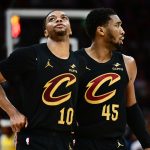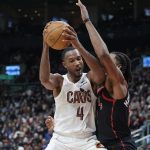
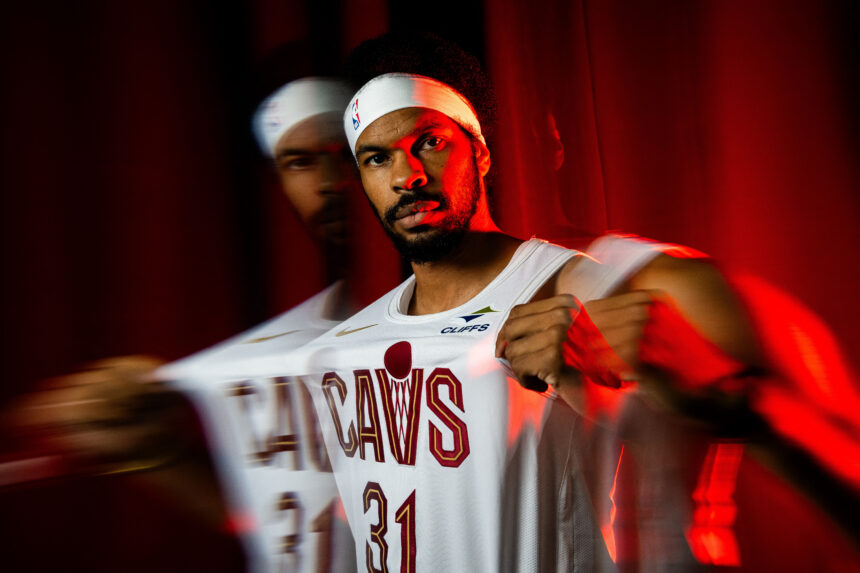
Jarrett Allen believes the Cleveland Cavaliers have the talent to finish on top of the Eastern Conference. With training camp underway, his confidence gives Cleveland a clear standard to measure itself against as the team works through how its pieces fit.
“We have every ability to be the best team in the Eastern Conference,” Allen said Thursday.
Allen’s statement describes what he believes the Cavaliers can become. It does not guarantee a finish or settle the questions Kenny Atkinson must answer about the rotation, but it places the ambition well beyond simply having another competitive season.
Cleveland’s last postseason ended with a 130-93 loss to New York and a four-game Eastern Conference finals sweep. That exit is the obvious backdrop to any discussion of how much higher this group can climb.
The useful question now is what could make the coming season different. A longer runway with James Harden, decisions about the players surrounding the stars and the balance between frontcourt size and spacing all belong in that conversation.
Allen’s belief will ultimately be tested by how well those parts work together.
Why a full season with James Harden matters
The Cavs have just 26 regular-season appearances for Harden with Cleveland last season. He averaged 20.5 points and 7.7 assists per game in those appearances, shooting 43.5 percent from 3-point range.
Those numbers establish an encouraging starting point, but the number of games is just as relevant to the next step. Cleveland can now use camp to work through combinations before the demands of the regular-season schedule begin dictating the pace.
For a team evaluating how to get the most from two primary ball-handlers, that preparation has practical value. Atkinson can examine when to keep Harden and Donovan Mitchell together, when to separate their minutes and which supporting players best complement each guard.
Those choices affect much more than the first substitution. A lineup built to maximize shooting may create cleaner driving lanes while asking more of its defenders.
A bigger group may offer different coverage options but require more deliberate movement to keep the offense from becoming crowded. Camp provides an opportunity to test those trade-offs without needing every experiment to produce an immediate win.
Harden’s Cleveland shooting percentage also deserves perspective. A strong stretch can reveal a productive partnership, but it should not become a requirement that he match the same percentage for an entire season.
Better organization and more reliable options when the first action fails would be meaningful improvements even without another shooting spike. The broader objective should be an offense that makes good decisions against different defenses.
If Cleveland can create advantages through more than one route, it will be harder for an opponent to reduce a possession to one difficult shot. That is a more useful measure of progress than assuming familiarity alone will produce a better finish.
Allen and Evan Mobley remain central to the answer
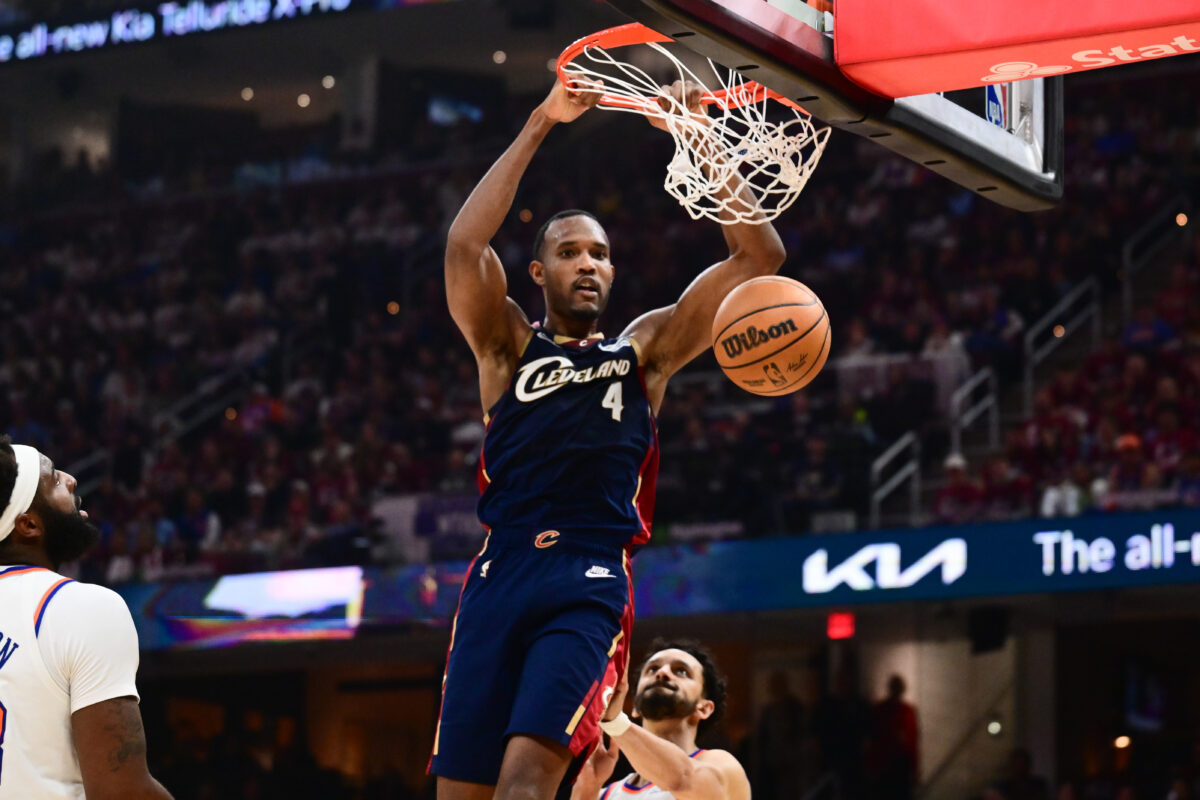
Allen has a direct role in making that structure work. He averaged 15.4 points and 8.5 rebounds per game while shooting 63.8 percent from the field last season.
Efficiency at that level gives Cleveland a reason to keep finding him near the basket. The challenge is to create those opportunities without letting the defense crowd the same areas that the guards need to attack.
Screening angles, the timing of a roll and the location of the other big man can determine whether a possession opens up or stalls. Evan Mobley’s development is part of that equation. He averaged 18.2 points, 9.0 rebounds and 3.6 assists per game, along with 29.7 percent shooting from three.
Those figures point toward a more specific discussion than simply asking him to score more. His passing can help connect possessions, while a more dependable outside shot could change how closely defenders need to guard him away from the rim.
Neither possibility requires Cleveland to abandon what its frontcourt already does well. Consider a possession in which a second defender steps toward Harden.
Mobley could become the receiver who has to choose quickly between attacking, finding Allen near the basket or moving the ball to a shooter. In that situation, the speed and quality of the decision matter as much as the initial play call.
Defensively, the same emphasis on connected decisions applies. Size offers less protection if the first rotation arrives late or a possession ends with an uncontested rebound.
Cleveland’s evaluation should include whether a lineup completes defensive possessions, not simply whether it can force an awkward first attempt. These are tactical possibilities to assess, rather than changes Atkinson has announced.
They illustrate why Allen’s optimism depends on collective execution: a frontcourt can influence a game through positioning, timing and decisions even when neither player dominates the scoring.
Kenny Atkinson still has lineup decisions to make
The coaching staff has already made clear that camp carries consequences. In comments on Sept. 25, Atkinson left the opening group undecided.
“The starting lineup is not set,” Atkinson said. “We have a whole training camp to work through that.”
#Cavs Kenny Atkinson: "The starting lineup is not set. We have a whole training camp to work through that." Also said he sees 13 guys who he could justify giving rotational minutes to this coming season.
— Chris Fedor (@ChrisFedor) September 25, 2026
As Cavaliers Nation previously covered, the decision extends into how minutes are allocated beyond the starters. Allen’s confidence should not be mistaken for an announcement that those choices have been resolved.
Cleveland acquired Peyton Watson from Denver in August’s five-team trade. His arrival gives the staff another combination to evaluate, but a transaction by itself cannot establish which five players will function best together.
There are also returning shooting options with a statistical case for consideration. Sam Merrill was at 42.1 percent from three and Jaylon Tyson at 44.6 percent last season.
That makes the choice more complicated than deciding who has the most recognizable name. A shooter may help the starters while leaving another unit short of spacing.
Moving that player to the bench could solve one problem while making the opening group easier to defend. Atkinson has to consider the sequence of lineups, not just their individual appeal. Starting and finishing games also need not produce the same answer.
The opponent, foul trouble and the kind of offense Cleveland needs late can all change the calculation. A productive camp would leave the Cavaliers with several combinations they understand, including clear reasons to use each one.
What Cleveland needs to show next
For now, there are concrete things to watch behind the confident statement: whether the ball moves after the first advantage, whether the big men receive it in useful positions and whether perimeter combinations can provide enough shooting without creating defensive problems.
The Cavaliers’ camp itinerary and preseason plans provide the next opportunities to examine those questions. Cleveland is preparing in Spain before its Oct. 8 preseason opener against Boston.
Preseason results will not establish where the Cavaliers belong in the East, but the possessions can show what the staff is testing. Who plays together, who handles the ball when a star sits and how the team responds to an opponent’s adjustment will be more revealing than a final exhibition score.
Allen has supplied the ambition. The work ahead is to identify the combinations and habits that can support it when an opponent has time to study Cleveland, take away its preferred options and demand a different answer.