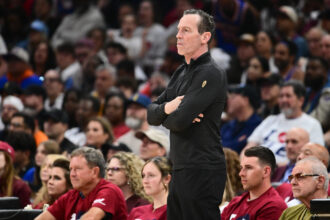
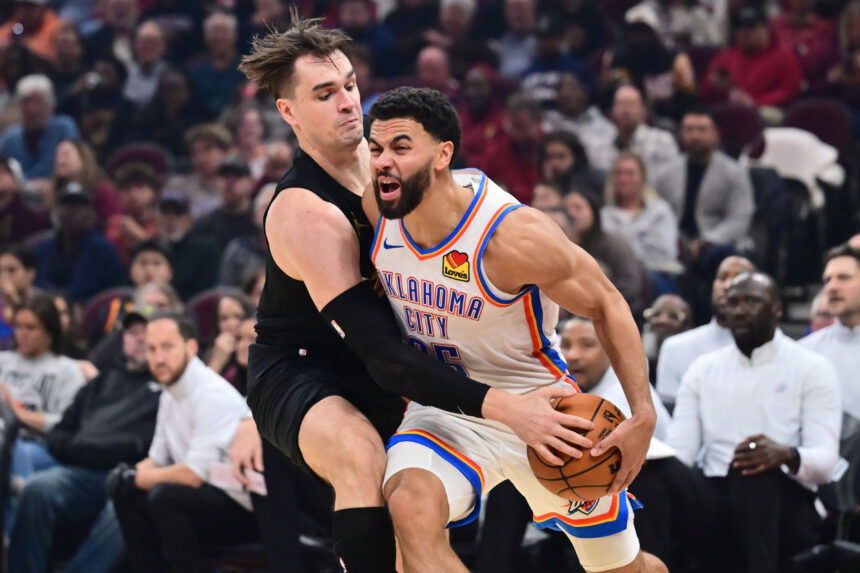
Kenny Atkinson acknowledged that keeping Mario Hezonja off the floor for the Cleveland Cavaliers’ closing stretch against the Oklahoma City Thunder was a difficult decision.
After Monday’s 117-112 loss, the Cavs coach discussed whether Hezonja should have been part of the group finishing the game. Atkinson described a choice the staff had debated, rather than one he considered obvious.
“We went back and forth,” Atkinson said. “You guys can definitely second-guess me on that one. I get it. It was really a 50/50 proposition.”
That acknowledgment leaves room to question the personnel without turning his comments into something stronger. Atkinson did not say Hezonja’s absence caused the loss or announce that the forward would close the next game.
Mario Hezonja gave the Cavs another closing option
Hezonja finished with 12 points, eight rebounds, three assists and two steals in 26:30, shooting 4-for-9 overall and 3-for-7 from 3-point range.
His contribution gives the lineup question substance. Cleveland had a forward available who had supplied outside shooting while also contributing on the glass and moving the ball.
Using him would not necessarily have required abandoning spacing to put another bigger player on the floor.
The late group was James Harden, Donovan Mitchell, Meleek Thomas, Sam Merrill and Evan Mobley, with Hezonja and Jarrett Allen out of that combination.
The basketball tradeoff is clear: A group built around guards can offer multiple players to initiate offense and threaten from the perimeter.
Adding a forward instead could provide another option for defensive matchups and rebounding. Neither benefit guarantees that a particular lineup will win its minutes.
Hezonja’s shooting also makes this more complicated than a simple offense-versus-defense argument. A forward who can make perimeter shots gives a coach a way to retain shooting while changing the physical profile of the group.
At the same time, his individual production cannot prove that Cleveland would have finished differently with him playing.
The useful question is what combination best answers the opponent and the game situation, rather than treating the final score as proof that every alternative would have worked.
Injuries complicated Cleveland’s perimeter choices
Cleveland entered the matchup with Peyton Watson dealing with a hamstring issue and Jaylon Tyson ruled out with an ankle injury. Both ultimately missed the game.
That context matters when assessing the smaller lineup. The Cavs were making their choices with fewer perimeter options available, although that alone does not establish which of the remaining players should have finished.
There is also an existing offensive reason for considering additional guards. Atkinson previously explained that Cleveland needed another ball-handler to support Mitchell and Harden when discussing Thomas’ opportunity.
That earlier explanation helps frame the broader rotation issue. It should not be mistaken for Atkinson’s stated reason for every substitution against Oklahoma City; his comments on Hezonja establish that the specific closing decision remained a close call.
Cleveland visits Oklahoma City again Wednesday. The rematch offers an immediate opportunity to revisit the combinations, but Atkinson’s acknowledgment by itself is not a commitment to a different closing five.