
Donovan Mitchell sees a specific challenge behind the Cleveland Cavaliers’ difficulty protecting leads: Opponents are disrupting their offense with pressure that does not always arrive in predictable places.
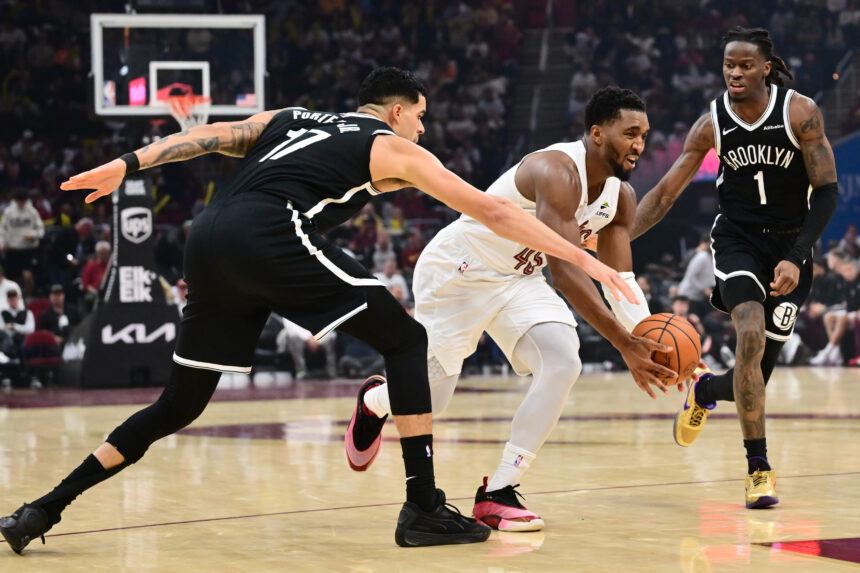
After Cleveland’s win over the Brooklyn Nets on Saturday, Mitchell described defenses picking up ball-handlers across the court and sending unexpected traps. He compared that unpredictability to a less structured style of play.
“There’s an unpredictability to it,” Mitchell said. “I think it’s random. The NBA has turned into that as a whole. Indiana really did a great job of it two years ago, and I think everybody followed suit. It was just like, just cause chaos and figure it out. … When you’re picking up full court and randomly trapping, there’s really no scheme for that. It’s like AAU basketball.”
The Cavs escaped with a 125-121 victory after leading 104-82 with 9:29 remaining. The finish gave Mitchell’s explanation immediate relevance, with Cleveland again having to find a way through an opponent’s rally.
The practical question is what happens after a second defender approaches the ball. Cleveland needs an available receiver and a quick next decision, otherwise the pressure can consume the possession before the offense creates a good shot.
Cavs had little room left after Brooklyn’s rally
The danger was measurable before the final seconds. With 26.4 seconds remaining, The Cavs had eight turnovers in the fourth quarter. Also, Peyton Watson had fouled out on an illegal screen, with the lead down to four.
That detail matters because turnovers require different remedies. An offensive foul and a pass intercepted out of a trap both cost a possession, but treating them as the same mistake can obscure what needs correcting.
The volume of the problem was the issue at that point; it does not classify all eight turnovers as failures against a double-team.
Barely any margin remained. Michael Porter Jr.’s 3-pointer made it 123-121 with 8.1 seconds left. Sam Merrill then converted two free throws with 5.2 seconds remaining to restore a four-point cushion.
The Cavs had already drawn Charles Barkley’s criticism after their opening-night collapse. Saturday supplied a new game to examine, with Mitchell identifying the defensive pressure Cleveland has to solve.
The next pass is part of the answer
Atkinson also emphasized ball security.
“We lost the possession game by 16,” Atkinson said. “We got to clean up the turnovers.”
One possible response is to bring a teammate into a shorter passing lane before the trap closes. If two defenders commit to Mitchell, that receiver can become the player who attacks the resulting space.
It gives the offense a chance to make the defense rotate rather than asking the trapped guard to dribble through both opponents.
There is a tradeoff. Moving a teammate toward the ball can compress the floor if another player is already occupying that area.
The passer and receiver therefore need coordinated spacing, and the receiver must be prepared to move the ball again. Simply escaping the first trap does not guarantee a productive possession.
Those are possible counters, not a claim that Atkinson has announced a new scheme. They also explain why evaluating the response requires more than checking whether Mitchell scored: The useful question is whether Cleveland turns extra attention on its guard into an advantage elsewhere.
Two games cannot establish that this is an unsolvable roster problem. They can give the coaching staff specific situations to address.
The next time an opponent pressures the ball, Cleveland’s progress will be visible in how quickly it finds an outlet and whether that first pass leads to a controlled possession. Saturday’s win left that work unfinished.