
Charles Barkley questioned the Cleveland Cavaliers’ toughness after their season opener gave him another reason to doubt how they handle adversity.
Cleveland lost 114-106 to the Philadelphia 76ers on Thursday after leading by as many as 29 points. Barkley’s reaction on “Inside the NBA” focused on the gap between the Cavs’ individual ability and their response when an opponent starts taking control.
Over two minutes of the Inside the NBA crew talking about the Cavs biggest issue.
Charles Barkley: "Well the problem is they don't have no dogs. They got some good players, some really good players, but you have to have a guy who imposes his will on the game." pic.twitter.com/shhz4869iB
— RealCavsFans.com (@realcavsfans) October 23, 2026
“Well the problem is they don’t have no dogs,” Barkley said.
Barkley acknowledged the quality of Cleveland’s players but argued that the group needs someone who can take command of a game. His criticism was about the team’s competitive response, rather than a lack of recognizable talent.
That assessment followed a collapse, with Philadelphia turning Cleveland’s biggest advantage into an eight-point defeat.
Cavs’ second-half deficit explains the frustration
The size of the initial lead was only part of the problem. Cleveland also failed to stabilize the game over the entire second half, allowing Philadelphia to erase the cushion and build enough separation to finish the comeback.
There was a 69-37 second-half advantage for the Sixers. Combined with the final score, that puts Cleveland’s halftime lead at 69-45: a 24-point cushion that became a 32-point deficit over the remaining two quarters.
| Scoring period | Cavaliers | 76ers | Cleveland margin |
|---|---|---|---|
| First half | 69 | 45 | +24 |
| Second half | 37 | 69 | -32 |
| Final | 106 | 114 | -8 |
First-half totals are calculated from the final score and the NBA’s second-half figures. Margins are Cavaliers points minus 76ers points.
Philadelphia’s rally also came from several directions. In the second half, Jaylen Brown and Tyrese Maxey had 17 second-half points apiece, Joel Embiid had 15 and LeBron James had 12.
Those four players combined for 61 points after halftime, 24 more than Cleveland’s entire team scored during that stretch.
The distribution matters: The Cavs needed answers for multiple scorers rather than one player whose hot shooting could explain away the result.
The scoring swing does not, by itself, prove Barkley’s judgment about the roster’s personality. It does show why the loss demands an explanation on both ends.
Cleveland’s offense produced 32 fewer points after halftime while its defense allowed 24 more.
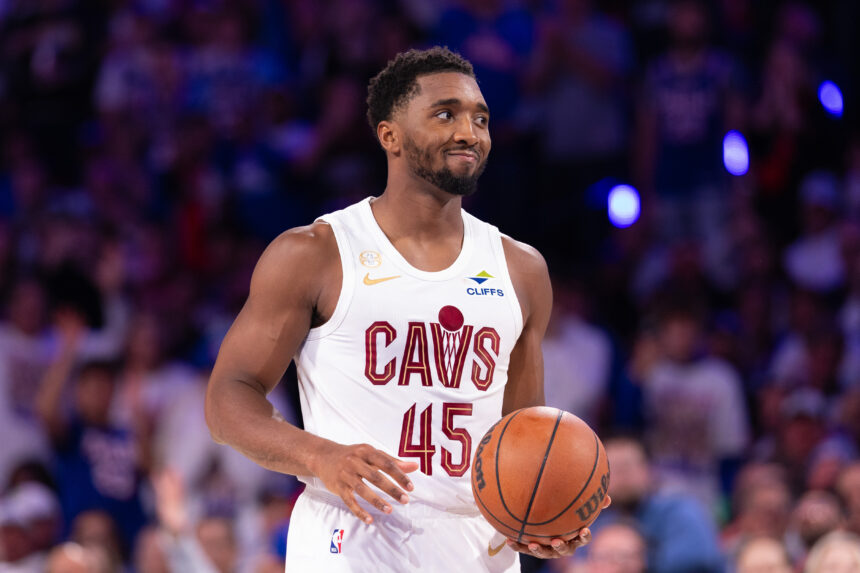
Donovan Mitchell puts responsibility on Cleveland
Mitchell’s postgame assessment also centered on what the Cavs failed to do.
“They’re a good team but at the end of the day, this loss is on us more than them,” Mitchell said.
That was an assessment of the game, not a response to Barkley’s television comments. Mitchell also identified Philadelphia’s second-half pressure as a problem Cleveland needed to solve.
Kenny Atkinson acknowledged that Philadelphia controlled the terms of the second half. He described the experience as an opportunity for his veteran team to develop resilience, but also conceded that its response had fallen short.
“When you have to face adversity like tonight, that second half, it was like a playoff game, playoff atmosphere,” he said. “We did some great things in the first half. We played Cavs basketball. But then they really imposed their will. We resisted. But in the end, we didn’t meet the challenge.”
That offers a more specific explanation than toughness alone. When an opponent increases pressure, the response has to include a workable way to advance the ball and create scoring chances.
Mitchell’s comments identify that adjustment as unfinished work, even though the Cavs had already shown they could score against Philadelphia earlier in the night.
Mitchell had recently defended Evan Mobley against outside criticism, emphasizing the confidence his teammate has inside the organization.
Thursday’s result creates a different challenge for that group: demonstrating that its belief in one another can survive an opponent’s sustained run.