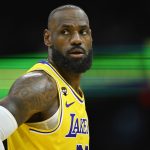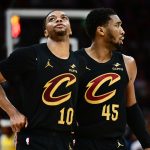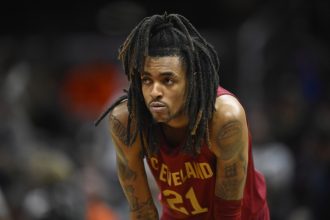
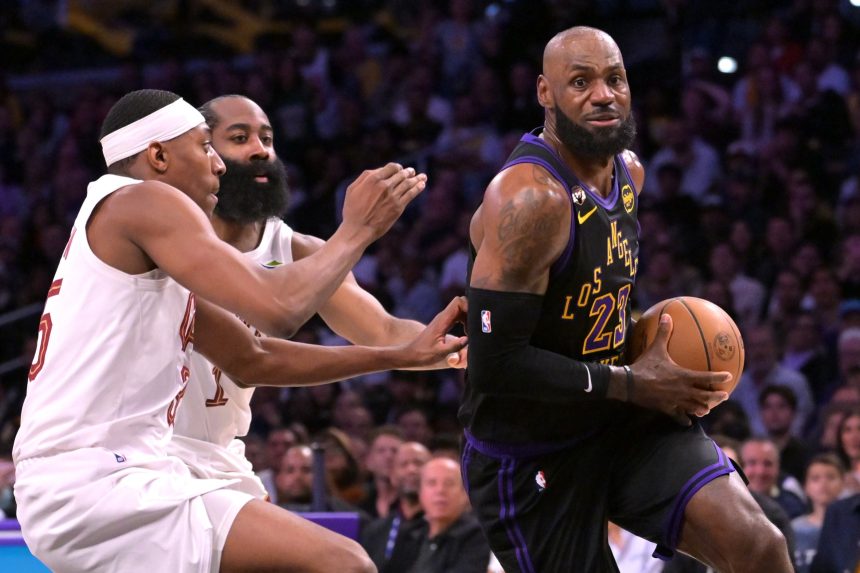
For the past two weeks, Rich Paul has occupied an awkward place in the Cleveland Cavaliers’ pursuit of LeBron James: the man running the process while simultaneously being cast as its biggest complication.
On Wednesday, LeBron’s longtime agent took direct aim at that narrative, telling Brandon “Scoop B” Robinson that his relationship with James Harden is nothing like the frosty one that has been portrayed.
“I like James Harden,” said Paul. “He’s actually my friend.”
The comment lands with real weight in Cleveland, because Paul himself is the reason the Harden question became a storyline in the first place. His clarification, delivered the same day ESPN reported that Philadelphia’s stars are actively recruiting James, quietly removes the most talked-about obstacle standing between the 41-year-old and a third stint with his hometown team.
What Rich Paul told ScoopB.com
Paul’s comments to Robinson went well beyond the Harden relationship.
According to the report, the Klutch Sports CEO said he carries no resentment toward the Cavs organization over February’s trade that sent his client Darius Garland to the Los Angeles Clippers in exchange for Harden, even though he was not a fan of the deal itself.
He pointed to his own history with the franchise, noting that he sat through Cleveland’s infamous 36-game losing streak and was in the building for LeBron’s return in 2014, and named Dan Gilbert, Chris Grant, Koby Altman and Brandon Weems as decision-makers he respects.
Notably, the inclusion of Grant — the former general manager who drafted Kyrie Irving and remains in Gilbert’s orbit — was dropped from most aggregated versions of the story, but it speaks to how deep Paul’s ties to the organization run.
Just as important was what Paul declined to claim: any influence over the outcome. He told Robinson that LeBron will make the call himself, positioning Klutch as a facilitator rather than a driver of the decision.
That echoes what Paul has signaled throughout this cycle, telling teams to expect a deliberate process rather than a quick resolution.
Why the walk-back matters
To understand why Wednesday’s comments matter, rewind to Paul’s now-famous whiteboard appearance on the “Game Over” podcast with Max Kellerman late last month.
Mapping out LeBron’s options on air, Paul identified Cleveland’s front office and Weems — whom he described as family to LeBron — as major positives, then flagged the roster’s guard situation as the drawback.
“Now, the negative is, and this is no offense to Harden, there’s no Darius Garland,” Paul said on the podcast, framing the loss of his own client as the downgrade in Cleveland’s pitch.
Rich Paul on the Positives and Negative of LeBron going back to Cleveland 👀
Positives: Big X factor, Brandon Weems. Brandon Weems is basically LeBron’s brother… That is a big feather in the cap
Negative: The negative is, no knock to Harden, but no Garland. He loves Garland… pic.twitter.com/RZo0UwApCk
— Heat Central (@TheHeatCentral) July 3, 2026
Fair or not, that framing hardened into a league-wide talking point: that Klutch viewed Harden as a poor fit next to LeBron, and that lingering tension between Paul and the former MVP — the two have a well-documented history, including a heated 2023 playoff corridor exchange in Boston — could steer LeBron elsewhere.
Robinson’s reporting undercuts both halves of that theory. Beyond Paul’s own words, sources close to Harden told ScoopB.com that Harden and LeBron get along fine and hold no grudges against one another.
The distinction Paul appears to be drawing is between a basketball evaluation and a personal one. Questioning whether an aging Harden replaces what Garland gave Cleveland is a roster argument.
It was never, by his telling, a feud — and by putting that on the record now, Paul has stripped the drama out of a storyline that had taken on a life of its own.
The Harden contract is still the real mechanism
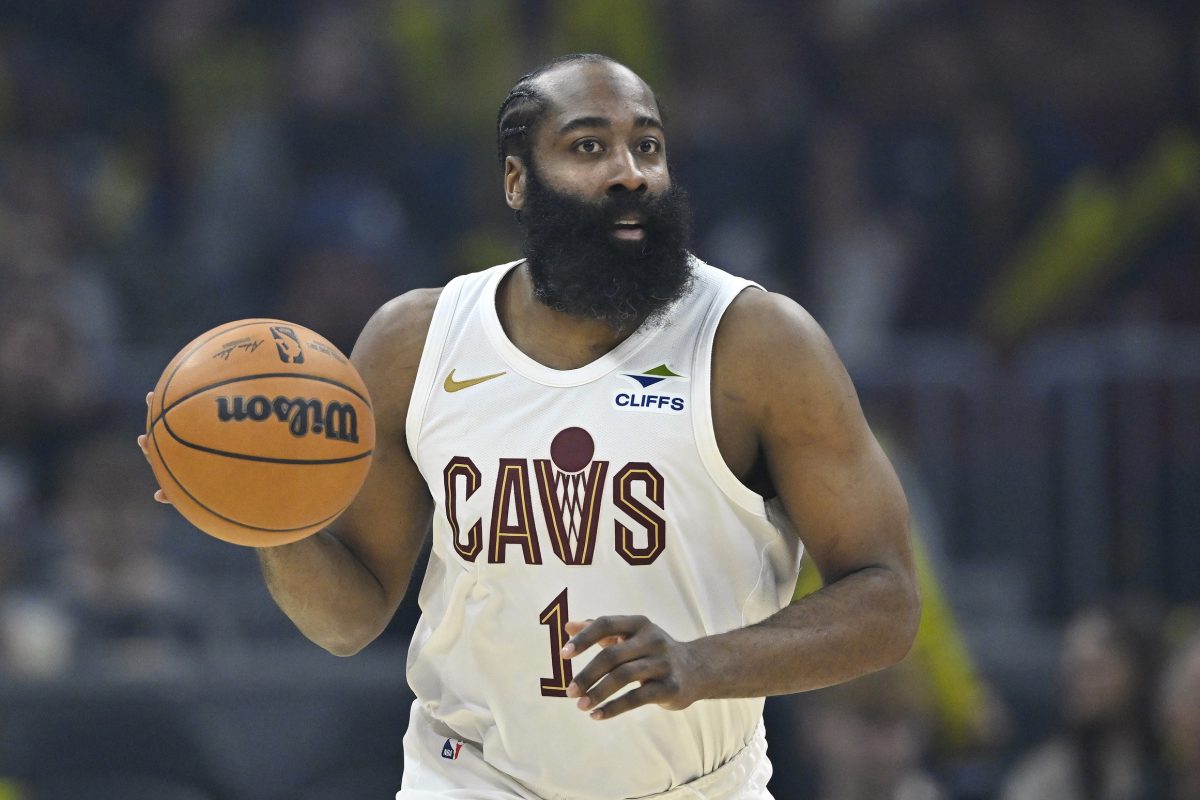
None of Wednesday’s clarity changes the fact that Harden’s next contract remains the hinge on which Cleveland’s entire LeBron scenario swings.
Harden declined his $42.3 million player option for 2026-27 late last month, and he and the Cavs have been working toward a new multiyear agreement since Harden’s decision to opt out.
The math is straightforward even if the negotiation is not. Every dollar Harden shaves off that $42.3 million figure is a dollar of breathing room beneath the aprons for a front office trying to fit another salary onto a capped-out contender.
That is why Harden’s opt-out was read around the league less as a cash grab than as a door being held open — a veteran star restructuring to make a bigger addition possible.
Paul’s comments slot neatly into that picture. An agent who genuinely disliked Harden had little incentive to say so publicly while his most famous client weighs joining Harden’s backcourt.
An agent clearing the air, on the other hand, is exactly what you would expect if the basketball and financial pieces are being lined up in good faith. That reading is speculative, but the timing is hard to ignore.
The Klutch two-front problem
There is one more layer that makes Paul’s neutrality claim genuinely interesting: His own agency is on both sides of this race. Hours before Robinson’s story published, ESPN reported that Tyrese Maxey, Joel Embiid and Jaylen Brown have all been in contact with LeBron on Philadelphia’s behalf, with Maxey — a Klutch client who trains with James in the offseason and has called him a big brother — leading the recruitment.
Paul acknowledged Philadelphia’s pursuit weeks ago, and on the whiteboard episode, he made a point of saying LeBron loves both Garland and Maxey. So the same agency now represents the player being chased, the point guard leading one suitor’s pitch and — in Garland — the guard whose departure Paul flagged as the other suitor’s flaw.
Against that backdrop, his insistence that LeBron alone will make this decision reads less like a talking point and more like a necessary firewall.
For Cleveland, the takeaway is that the recruiting battle is real and active on multiple fronts. Head coach Kenny Atkinson has already acknowledged the stakes publicly.
Where this leaves the Cavs
Cleveland’s case was never really about whether Rich Paul liked James Harden. It rests on the roster that reached the Eastern Conference finals, the organizational ties Paul himself keeps listing, a locked-in franchise centerpiece and a front office that has spent the summer preserving flexibility rather than spending it.
What Wednesday changed is the noise around that case. The loudest argument against a homecoming — that LeBron’s own camp viewed the Harden trade as disqualifying — no longer has its supposed author behind it.
What has not changed is the timeline. Paul has offered no window for a decision, the Harden negotiation remains open and Philadelphia is pressing.
The Cavs have done what they can do from the outside. From here, the two men who matter most are the one weighing the decision and the one who just made clear he will not be blamed for it.