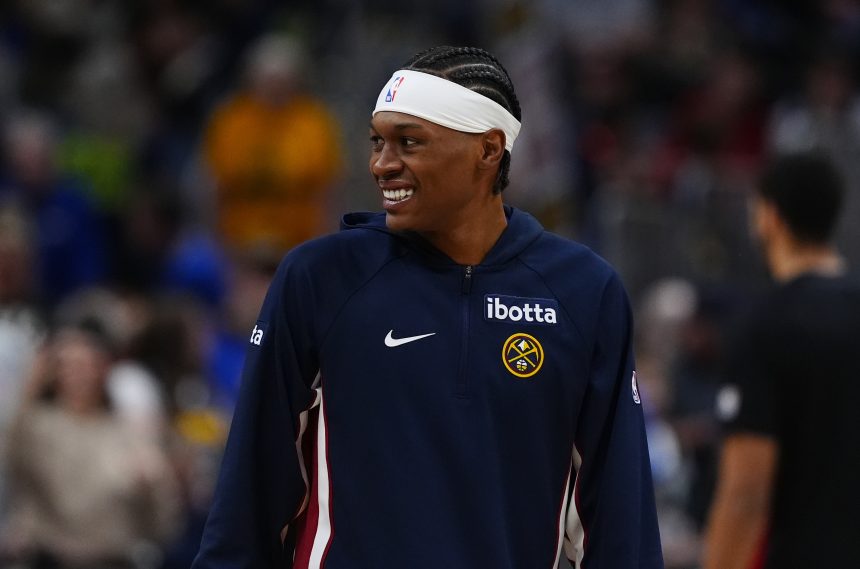
The Cleveland Cavaliers’ pursuit of Peyton Watson stopped being a rumor last week and became a phone call. According to HoopsHype’s Michael Scotto, the Cavs have contacted the Denver Nuggets to express interest in a sign-and-trade for the restricted free agent forward, moving Cleveland from the edge of the Watson conversation to the middle of it.
What has happened since that call is nothing, and the reason is not a lack of effort on either side. It is a collision between what the Cavs want to build and a set of salary cap rules that currently make almost every trade idea circulating among fans impossible as constructed.
With NBA insider Marc Stein joining DNVR Nuggets’ show Monday to dig into the latest on Watson and Denver’s cap situation, the standoff remains one of the league’s most closely watched unresolved storylines.
The call Cleveland made
The Cavs’ wing search has been public since LeBron James chose the Philadelphia 76ers in free agency. Cleveland.com’s Chris Fedor laid out the fallback board late last month, a list headed by Jonathan Kuminga, Watson and DeMar DeRozan, while noting that none of the paths was simple.
The Hezonja signing gave the rotation a veteran body, but the front office has made clear through its actions that it does not consider the wing problem solved. The call to Denver formalized that.
Scotto reported that Cleveland registered its sign-and-trade interest directly with the Nuggets, and that sharpshooter Max Strus and veteran guard Dennis Schroder are the Cavs’ most logical trade candidates as the roster stands. Strus is set to earn $16.7 million next season and Schroder carries a $14.8 million cap hit, the kind of mid-sized expiring money that usually makes a deal like this work.
Usually. This is where the arithmetic takes over.
The rule that freezes every trade idea
Denver’s offseason changed shape in late July, when the Oklahoma City Thunder signed restricted free agent Spencer Jones to a two-year, $12 million offer sheet and the Nuggets matched it.
Matching kept a rotation piece, but it also pushed Denver above the NBA’s second apron, and it raised the franchise’s projected luxury tax bill from $36 million to $68 million.
That matters for Cleveland because of a specific consequence of apron life. A team operating above the second apron is not allowed to receive salary back when it sign-and-trades its own free agent.
As long as Denver stays where it is, the only compensation it can legally collect for Watson is draft capital. Read that against the trade frameworks that have circulated all week.
Strus for Watson does not work. Schroder plus a pick for Watson does not work. Any construction that sends a Cleveland contract to Denver requires the Nuggets to first shed enough money elsewhere to duck below the apron line, and the candidates for that kind of salary dump are significant names.
Aaron Gordon at $31.9 million and Cam Johnson at $23 million represent the most realistic paths under the threshold, and there has been no reported indication Denver is inclined to move either one.
What Denver is asking for
The Nuggets’ price has been the other obstacle. Denver opened these conversations seeking compensation matching what Utah extracted from the Los Angeles Lakers for Walker Kessler, a package built on two first-round picks and two swaps, and that suitors declined to go there.
More recently, ESPN’s Shams Charania indicated the ask has softened to one high-level player and one first-round pick. Note the tension inside that ask: A player-inclusive return is exactly what the second apron currently prohibits Denver from taking.
The Denver Nuggets have decreased their asking price in Peyton Watson sign-and-trades frameworks to the following, per @ShamsCharania
– One “high-level player”
– One first-round pick(h/t @APH00PS) pic.twitter.com/zv7ERzKvqu
— Fullcourtpass (@Fullcourtpass) July 28, 2026
Either the Nuggets get under the line first, or the softened price is theoretical. Watson holds his own card, too. Stein reported that league sources say the 23-year-old has been “weighing the unappealing prospect” of playing next season on his $6.5 million qualifying offer, which would make him an unrestricted free agent in the summer of 2027.
Denver’s initial offers were believed to sit around $70 million over four years, per Stein, short of the $25 million average annual value teammate Christian Braun landed in his five-year, $125 million extension last fall — and short of where Watson’s camp wants to be.
What the Cavs can actually offer
Strip out the illegal constructions and Cleveland’s realistic menu is short. The Cavs can offer a picks-based package and hope Denver’s appetite for draft capital outweighs its preference for a player.
They can wait for Denver to clear apron room, at which point Strus or Schroder money becomes usable matching salary. Or they can wait the situation out entirely and see whether Watson’s qualifying offer leverage forces the Nuggets into a decision on their own timeline.
None of those paths is fast, and that is the context for the quietest part of Cleveland’s offseason.
Why James Harden is still waiting
Harden declined his $42.3 million player option in late June and remains unsigned, and the two storylines are the same storyline.
ESPN’s Ramona Shelburne connected them directly on “NBA Today” last week, saying “the Cavs are still poking around with Peyton Watson” while crediting Harden with giving the front office room to negotiate.
Scotto’s reporting matched that tone, describing the Harden talks as “harmoniously” progressing toward a deal structured to pay the guard fairly while preserving flexibility for exactly this kind of move.
Every day Harden stays unsigned is a day Cleveland keeps its cap picture moldable. The moment his deal is announced, read it as a signal about how the front office believes the Watson chase ends.
The player worth the trouble
The reason Cleveland is enduring all of this math is that Watson profiles as precisely what the roster lost this summer. Per Basketball-Reference, the 6-foot-8 forward set career-highs across the board in 2025-26, averaging 14.6 points, 4.9 rebounds and 2.1 assists per game while shooting 49.1 percent from the field, 41.1 percent from 3-point range and 73.0 percent from the line across 54 games and 40 starts.
He turns 24 in September, won a championship as a rookie in 2023 and pairs that scoring growth with the length and shot-blocking instincts that made his name.
He has apparently spent the summer adding to the frame, too. Watson is now up to nearly 220 pounds after being listed at 200 last season.
Peyton Watson now weighs almost 220 pounds 💪
He was listed at 200 last year. pic.twitter.com/YWYjpgdzNj
— DNVR Nuggets (@DNVR_Nuggets) August 3, 2026
For a Cavs team that watched its wing depth walk out the door in July, that is a tantalizing profile. Whether it ever wears wine and gold comes down to three exits: Denver sheds salary, Denver takes picks, or Watson signs the qualifying offer and this whole pursuit resets to next summer.
Until one of those doors opens, expect the quiet to continue — and expect Harden’s signature to be the first sign it has.