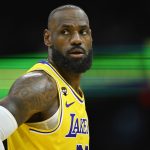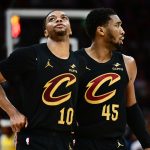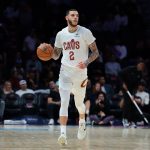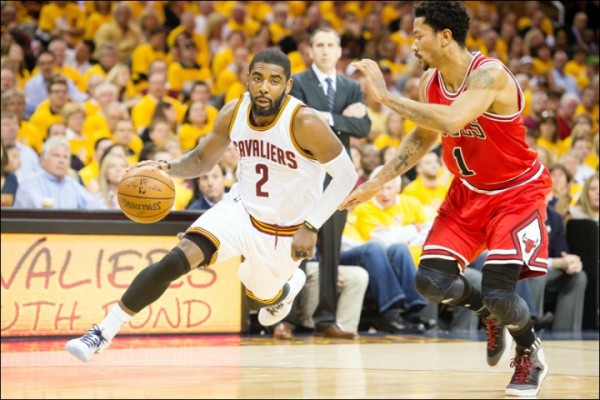
Bleacher Report’s Greg Swartz floated a three-team framework on Wednesday that would bring Kyrie Irving back to Cleveland a decade after he and LeBron James delivered the franchise its only championship.
In it, the Cavaliers receive Irving, Daniel Gafford and Naji Marshall from the Dallas Mavericks. The Miami Heat get James Harden. Dallas takes back Jarrett Allen and Dennis Schroder from Cleveland, plus Davion Mitchell and Nikola Jovic from Miami.
The stated purpose is to hand the Cavaliers a recruiter with 2016 credentials while James weighs his free agency. The Cavaliers made Donovan Mitchell’s four-year, $273 million extension official Thursday, and the roster question that follows it is real.
It cannot be executed, however, and the reason surfaces before you reach the second name in the deal.
Harden isn’t a trade asset
James Harden does not have a contract. He declined his $42.3 million player option in late June and is working through a new multiyear agreement with Cleveland, sources told ESPN’s Shams Charania. ESPN’s Bobby Marks lists him in the Cavaliers’ 2026 free agent class as an unrestricted free agent with full Bird rights.
You cannot trade a player who is not under contract. Harden would first have to sign in Cleveland, and the Cavaliers would then have to send him to Miami as part of a sign-and-trade, an entirely different transaction with its own conditions attached to the team receiving him.
That distinction is not a technicality. It is the pivot the whole framework rests on, and the proposal treats it as a formality.
Miami’s books say no
Then there is the team on the other end of that pivot. Because the Heat used more than 100 percent of the traded player exception to acquire Giannis Antetokounmpo, they are hard-capped at the first apron for the season. He put them roughly $20.5 million below that ceiling with as many as five roster spots left to fill.
Harden’s market number does not fit inside that, not with a bench to build around it. Miami’s own summer priority is replenishing perimeter shooting on a budget. Adding a 36-year-old lead guard on eight figures is not a version of that priority. It is the opposite of it.
Cleveland is trying to duck a line, not cross one
The deepest problem is that the trade misreads what the Cavaliers are doing this summer.
Marks laid out Cleveland’s toolbox at the end of June, and it is spare: the $6.1 million taxpayer midlevel exception, the veteran minimum and a second-round exception. Not the $15 million non-taxpayer midlevel that Golden State and San Antonio can spend.
He also spelled out the point of Harden’s opt-out — that a structure like a two-year deal worth $56 million, starting at $28 million, would put Cleveland beneath the second apron even once the roster is filled out.
Read that carefully. Harden declined $42.3 million so the front office could climb below a threshold, and the entire offseason has been arranged around getting there.
Irving’s salary is the largest on Dallas’ roster; he is the only Maverick earning more than $20 million. Absorbing it is not a step toward the second apron. It is a leap over it, in the wrong direction, in service of a player Cleveland would then lack the tools to build around.
Dallas has already answered
The Mavericks are hard-capped at the second apron themselves after sending cash to the Lakers, which sharply constrains what they can take back in any Irving deal.
They have also said no. Marc Stein reported last month that Dallas continues to tell rival front offices Irving is not available despite inquiries.
Team president Masai Ujiri went further in public, telling reporters on May 20 that he is curious to see Irving alongside Cooper Flagg. “I think Kyrie will fit,” Ujiri said.
Marks reached the same conclusion from the cap sheet, writing that a Dallas team short on clutch-game execution and high-level playmaking should keep Irving, at least for now. Two independent reads, one from reporting and one from the ledger, land in the same place.
And then there is the player
Set the mechanics aside and the basketball case is thinner than the nostalgia suggests.
Irving is 34 and did not play a minute of the 2025-26 season while rehabilitating a torn ACL. Before the injury he was excellent, averaging 24.7 points, 4.8 rebounds and 4.6 assists per game while shooting 47.3 percent from the field and 40.1 percent from 3-point range.
That was a season and a half ago. He has two years remaining on his deal, including a $42.4 million player option for 2027-28.
Harden, whatever his postseason limitations, played 26 games for Cleveland after the deadline and averaged 20.5 points, 7.7 assists and 4.8 rebounds per game on 46.0 percent shooting.
Trading that for a guard who has not appeared in an NBA game since 2025, in order to recruit a 41-year-old who has not committed to anything, is a sequence of bets stacked on top of one another. Each one has to land.
The two doors that are actually open
None of this means Cleveland is out of the LeBron James race. It means the paths are the ones that were already there.
The first is the veteran minimum, which is what the Cavaliers have if nothing else changes. However, James will leave roughly $11 million on the table relative to what Golden State can offer through the full midlevel.
The second is a sign-and-trade of Cleveland’s own, and it has one obvious shape. Speaking on ESPN Cleveland in late June, Brian Windhorst described Los Angeles taking back Jarrett Allen in exchange for James, noting that “the Lakers would kill for Jarrett Allen,” per ESPN’s offseason buzz file. That deal costs Cleveland a starting center rather than a starting point guard, and it does not require Dallas to change its mind about anything.
Neither door leads to Kyrie Irving. Both were open before the proposal, and both are still open now, which is the part that gets lost when a good story arrives to fill a slow week. The Cavaliers spent Thursday signing the one contract they controlled. The rest of their summer runs through the one they haven’t.