
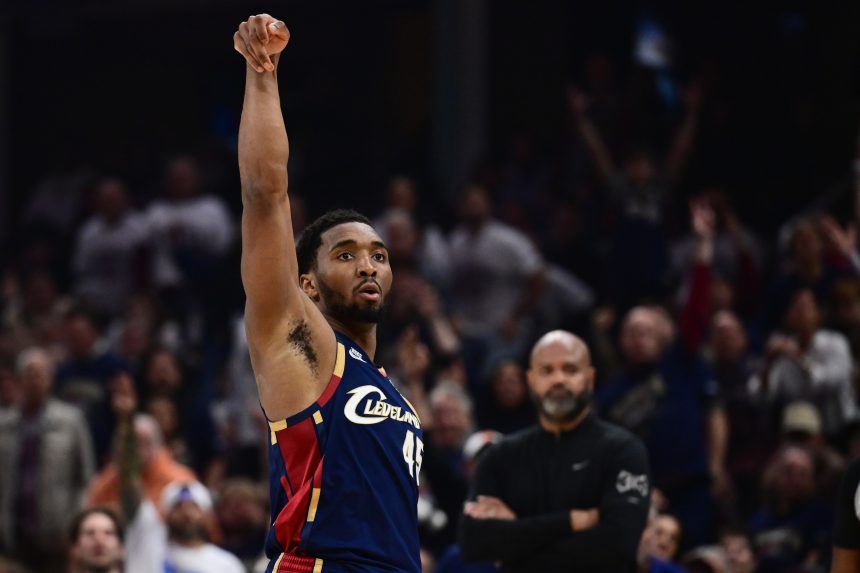
Cleveland didn’t just keep Donovan Mitchell. It made him the highest-paid player in the NBA.
The Cavaliers and their All-NBA guard agreed to a four-year, $273 million maximum extension on Tuesday, ESPN’s Shams Charania first reported, a deal whose average value of just over $68 million a season edges Shai Gilgeous-Alexander’s for the richest annual salary in league history. Mitchell signed on the first day he was eligible, and whether he wanted to stay was never really the question.
The harder question is what Cleveland just committed to, and whether a record contract that runs to the end of the decade is the bet that finally pushes this team past the East’s best. The signing is the easy headline. The wager underneath it is the story.
The richest average salary in the league
Mitchell’s $68 million annual average is a first for the NBA, narrowly clearing the $67.9 million average on Gilgeous-Alexander’s Oklahoma City deal.
In total dollars, the $273 million ranks fourth all time, behind only the $314 million Jayson Tatum received from Boston, the $285 million the Celtics gave Jaylen Brown before trading him to Philadelphia and the $276 million Nikola Jokic is playing on in Denver.
The structure underlines how far Cleveland is willing to go. The final season, in 2030-31, is a player option worth roughly $76 million, which hands Mitchell control at the back end. The deal also carries a full trade kicker, the maximum bonus allowed under the collective bargaining agreement, worth 15 percent of the money left on the contract.
Taken together, the terms make Mitchell both extraordinarily well paid and genuinely hard to move. That is the point. A franchise does not attach a full trade kicker to a player it wants flexibility to reconsider.
The money Mitchell walked away from
The most revealing figure in the negotiation is the one Mitchell didn’t take. Because he signed in the summer of 2026 rather than waiting a year, he locked in at 30 percent of the salary cap.
Had he held off until the completion of his 10th season, he would have qualified as a veteran eligible for 35 percent, along with an added fifth year. That patience would have pushed the deal toward five years and roughly $350 million, about $80 million more than he agreed to. He passed on all of it to commit now.
That trade of dollars for certainty runs against how these standoffs usually go, and it lands with particular weight in a market conditioned by LeBron James leaving twice to fear the worst whenever a star’s future comes into question. A cornerstone volunteering to lock in early, and leaving real money behind to do it, is close to the opposite of that experience.
Cavaliers president of basketball operations Koby Altman had framed the stakes weeks earlier, calling Mitchell “that’s our best ambassador, that’s our best recruiter” while discussing an extension in late May. Getting that answer in writing, on team-friendly terms, gives the front office a fixed point to build from.
The bet, and the risk inside it
Cleveland is paying for production it has already banked. Across four seasons with the Cavaliers, Mitchell has averaged 26.7 points, 5.3 assists and 4.6 rebounds per game, made every All-Star team and earned three All-NBA nods, including a First-Team selection in 2025.
This past season he posted 27.9 points, 5.7 assists and 4.5 rebounds per game and carried Cleveland to the first conference finals appearance of his career, the franchise’s first trip that deep since 2018.
The risk sits on the back end of the deal. A record annual salary that runs through 2030-31 will pay Mitchell deep into his mid-30s, an age at which guards who rely on burst and shot-creation historically begin to slide.
His postseason ledger complicates the picture too, since his defense has been a target in the biggest series and his scoring has not always been enough to cover it. The Knicks swept the Cavaliers out of the conference finals this spring, and Mitchell averaged 26.0 points per game across a run that again fell short of the standard he sets for himself.
He told reporters afterward that he still has “unfinished business” in Cleveland, and the front office has now answered that declaration with the richest average salary the league has ever paid. The two sides are betting on the same thing.
What the extension actually unlocks
The real value of settling Mitchell now has less to do with him than with everyone Cleveland still has to sort out around him.
James Harden, acquired at the trade deadline, is expected back after declining his player option for 2026-27, likely on a figure that helps the Cavaliers preserve some flexibility beneath the second apron. With the backcourt effectively spoken for, the front office can turn to the move that would define the offseason.
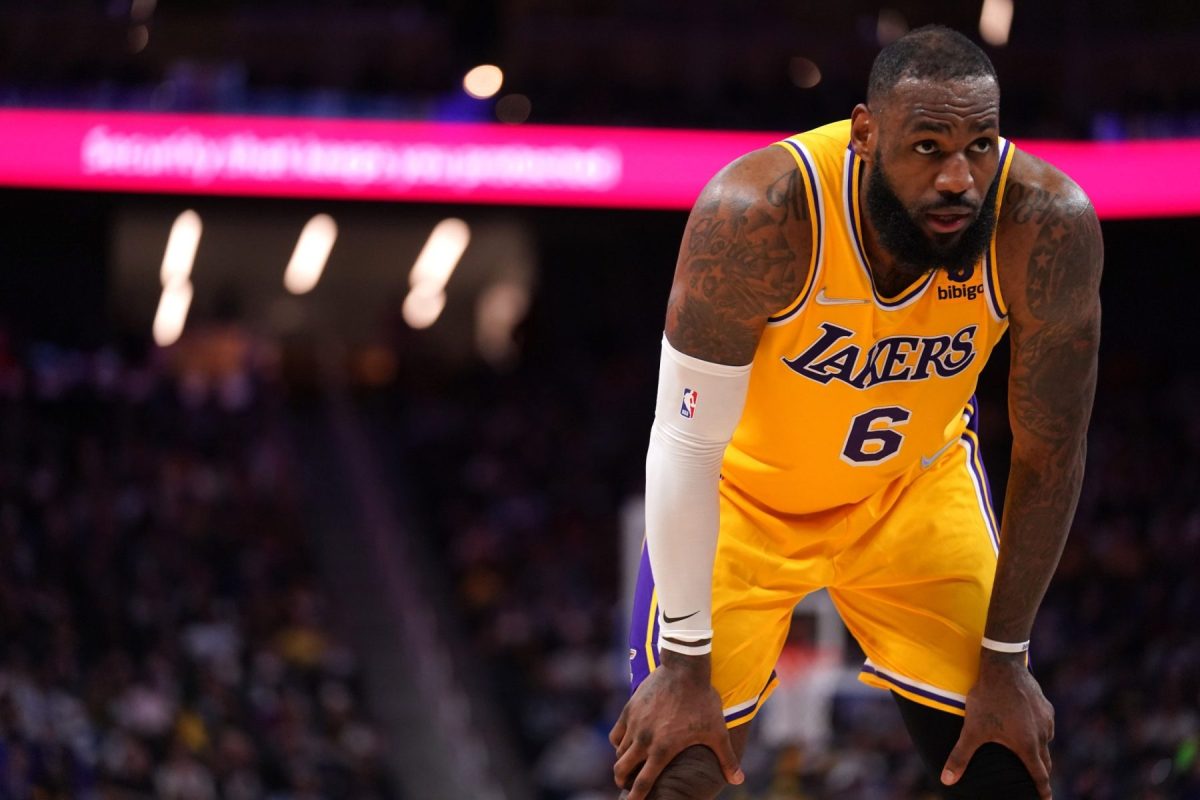
That move is LeBron James, and Cleveland has emerged as a real contender to land him, though the reporting deserves the caution attached to it.
Windhorst said Tuesday that people around the league are working off little more than instinct, and while he agreed the read points toward Cleveland, he cautioned, “But it’s just vibes.”
James, coming off the end of his run in Los Angeles, led Cleveland to its only championship in 2016, and Mitchell would welcome the reunion, according to ESPN. A competitive offer, however, would require the Cavaliers to shed salary they do not obviously have, which is where the trade kicker on Mitchell’s deal quietly matters: Whatever Cleveland moves to create room, it will not be him.
Bottom line
Cleveland has answered the one question it fully controlled: Its franchise player wants to be here, long term, on the richest annual salary the league has ever paid. That is the floor.
The ceiling depends on whether the front office can convert a record commitment into a roster capable of beating the Knicks, and whether the aging curve stays generous enough for the back half of the deal to hold up as well as the front. Mitchell did his part on the first day he could. The harder work now belongs to everyone else in the building.