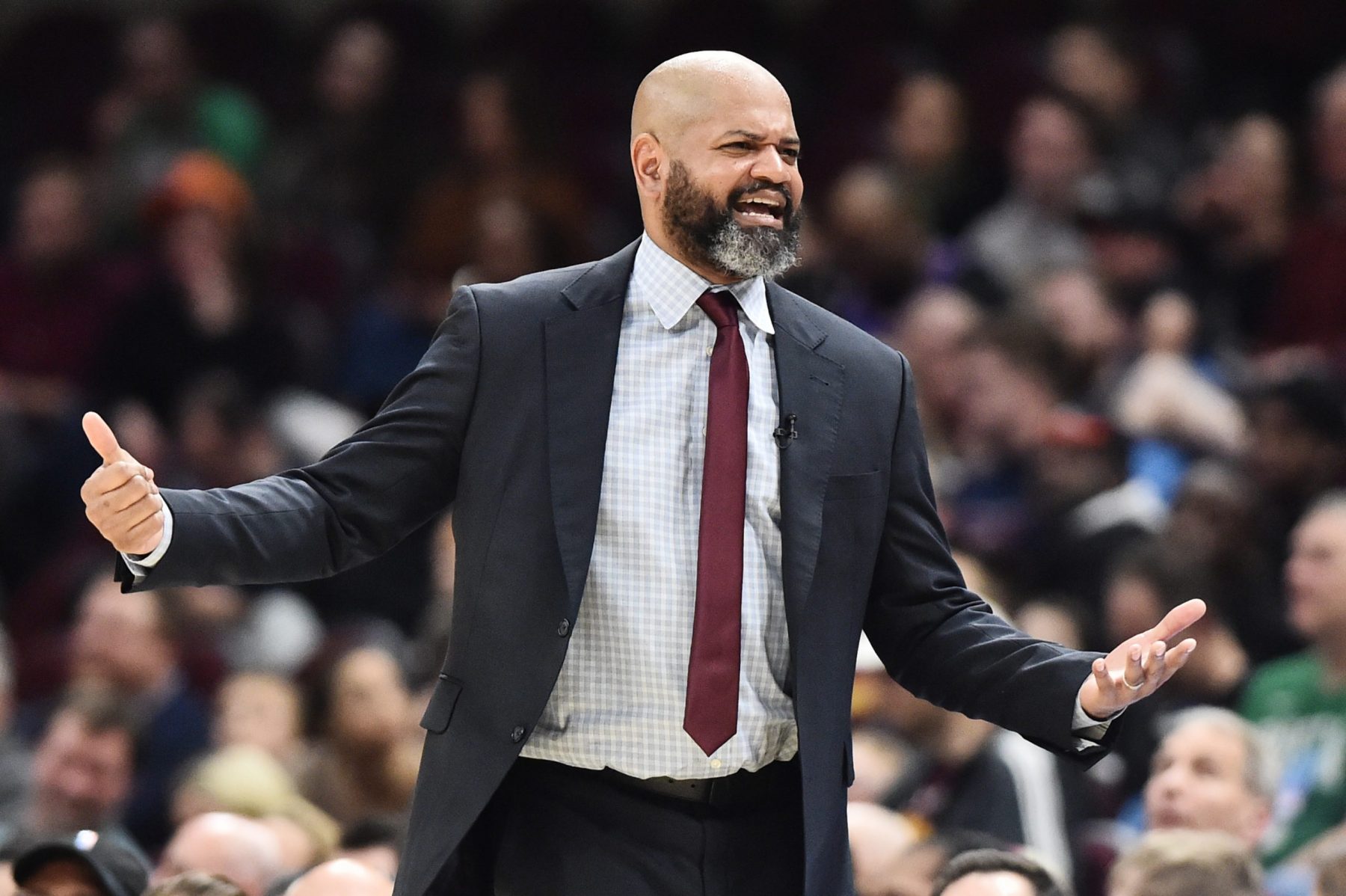

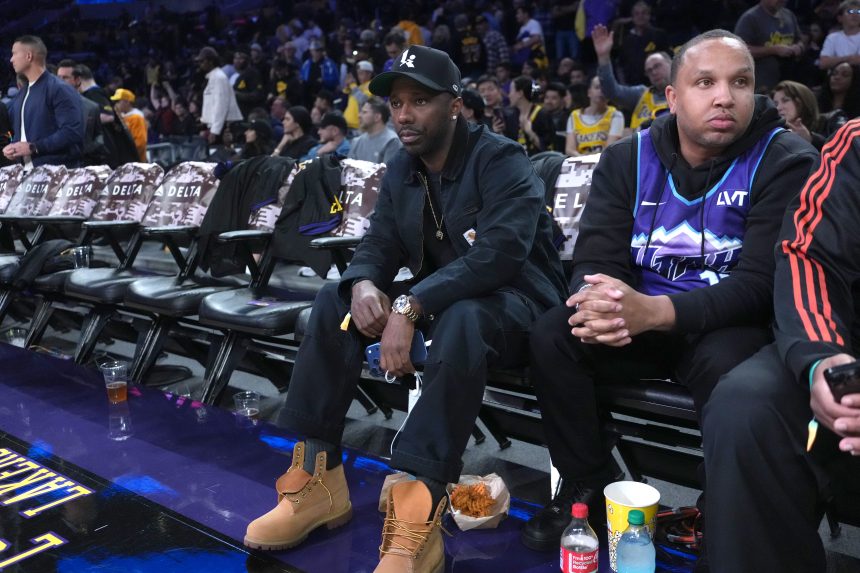
For a week, the biggest question in the NBA has been where LeBron James intends to spend his 24th season, and for a week, the answer has been a shrug.
On Friday, his agent changed that — not with a report, but with a marker and a whiteboard. On the newest episode of his Game Over podcast with Max Kellerman, Rich Paul laid out 10 teams he framed as James’ realistic options and walked through the case for each.
Cleveland was not scribbled in a corner. It got the full treatment, and by the end of the segment the national read — including a CBS Sports breakdown that pointed to the Cavaliers’ relationships as the separator — was that Cleveland might be the team to beat.
That is a stunning place for the Cavaliers to be for a player they cannot outbid other teams for, which is exactly why it is worth separating what Paul said from what Cleveland can actually do.
What Paul put on the board
Paul’s whiteboard listed 10 teams and gave five of them full projected lineups: Philadelphia, Miami, Cleveland, Denver and Minnesota. The other five — Golden State, Dallas, Boston, San Antonio and New York — sat on the periphery, referenced but not diagrammed the same way. Paul was blunt about why the exercise existed at all, telling Kellerman that had the Knicks not won the championship, there would be no board and James would already be headed to New York.
The most telling wrinkle was where he did not place the presumed favorite. Golden State, long treated as the frontrunner, landed off to the side with only Stephen Curry and Draymond Green listed. When Kellerman pressed him on the placement, Paul declined to explain himself.
“This is my board, you decide what you want to think,” he said.
For a fan base that has spent a year bracing for James to choose the Warriors, seeing the Cavaliers drawn up in full while Golden State floated on the margins was the first real jolt of optimism in a while.
The relationships that push Cleveland to the front
When Paul reached the Cavaliers, he spent less time on the roster than on the people. He acknowledged owner Dan Gilbert and the Gilbert family, then president of basketball operations Koby Altman, before landing on the name he clearly wanted to emphasize: assistant general manager Brandon Weems. Paul called Weems the “X-factor” and described him as “basically LeBron’s brother,” a friendship that predates any of James’ stardom.
That is the part Cleveland can sell that no cap sheet captures. Tthere may be no organization outside of Miami where James has deeper built-in trust than the one that drafted him, and Cleveland’s front office is stocked with people he has known for two decades. Paul’s framing made the logic plain: those ties are why the Cavaliers, in CBS’ read, “may be the frontrunner at this point” even without the money rival suitors can offer.
The one problem Paul flagged
It was not all a sales pitch. Paul named a real negative, and it is one Cleveland fans already feel: Darius Garland is no longer on the roster after being moved in the deal that brought back James Harden. Garland, a Klutch Sports client like James, mattered to the recruitment.
“No offense to Harden, but no Garland, because he loves Garland like he loves Maxey,” Paul said, tying James’ fondness for Garland to his well-documented affection for Philadelphia’s Tyrese Maxey.
It was equal parts scouting note and agent’s reminder that a Klutch connection tends to grease a recruitment — the kind of tell Paul tucks into an offhand line.
A starting 5 that already works
Strip away the sentiment and the on-court case holds up. Cleveland reached the Eastern Conference finals last season built around Donovan Mitchell and James Harden in the backcourt, with Evan Mobley and Jarrett Allen anchoring the frontcourt. Dropping James into that group hands head coach Kenny Atkinson one of the deepest top-end rotations in the conference, and it does not ask the Cavaliers to tear down their identity to make the fit work.
Paul also pushed back on the notion that Cleveland would gut that core to clear a path, waving off any suggestion that Mobley — one of the league’s premier defenders and the youngest cornerstone of the group — was ever available in trade talks. That matters to the pitch: the Cavaliers are not selling James a rebuild he has to rescue. They are selling a finished contender that needs a finishing piece.
Where the romance meets the cap
This is where the whiteboard glow meets the spreadsheet. The Cavaliers cannot pay James anything close to his market value. Operating deep in the luxury tax, they have no access to the roughly $15 million non-taxpayer mid-level exception that Golden State can dangle, and the most they can put in front of him outright is the veteran minimum, a figure near $3.9 million.
There is one accounting quirk that softens the blow: Because of how minimum contracts are reimbursed, a James signing would count only about $2.5 million against Cleveland’s cap, as CBS Sports’ Sam Quinn detailed. It is still a sliver of what a healthier suitor could offer.
None of it moves without James Harden. Harden declined his $42.3 million player option and is working on a new multiyear deal whose structure can be used to soften Cleveland’s 2026-27 cap number rather than inflate it, which is why the order of operations is so delicate.
The fuller mechanics — including the most-floated sign-and-trade framework, which would ship Jarrett Allen to a Lakers team desperate for a center — are laid out in our earlier breakdown of what it would actually take for the Cavs to sign LeBron James. The short version: For a homecoming to happen, either James accepts a near-minimum number to force it through, or Cleveland threads the first-apron needle by shedding a rotation anchor. Neither is simple, and neither side has signaled it is ready to make that sacrifice.
The fan calculus
For Cleveland’s fan base, the pull is almost entirely emotional, and reasonably so. This is the player who defines the franchise, floating the possibility of ending his career where it started. The counterweight is just as real, and it is showing up in the fan discourse: unease about the on-ball overlap between Harden and James, and a deeper reluctance to trade Allen or gut a top-four East roster for what could amount to a farewell tour.
Paul’s insistence that Mobley was never on the table took some of the edge off that fear, but the tension is the story — hope on one side, roster preservation on the other.
What happens next
Paul attached no timeline, and by his own telling James has heard from nearly every team in the league, so “LeBron Watch” could stretch on for a while. What changed Friday is the framing. A week ago the Cavaliers were a sentimental long shot chasing a player the Warriors could simply outpay.
Today they are drawn up in full on their agent’s whiteboard, read by national observers as a frontrunner, with the only remaining obstacle being the one thing relationships cannot solve — the math.